Donnerstag, 21. Februar 2008

I am still alive ( in Ethiopia)

Kassala


I just couldn't find any opportunity to write a new blog entry in the rural areas of northern ethiopia during the last 4 weeks and on the day I stayed in Gonder, my first stopover within Ethiopia , www.blogger.com was not accessable.

So what happened in the mean time? My second attemp to conquer Kassala turned out to be successful and I stayed there for 5 days. Though it's one of the biggest and most famous cities of Sudan, it's character is rather like a big village. The "downtown" is very small and as ugly as most other cities, and after 9 p.m. the streets are entirely empty. Only during ramadan , as I was told, the city gets more alive, because many sudanese couples spend their honeymoon there. Like me, they are attracted by the coulisse of the famous Tutil mountain nearby.

As Kassala is very close to the border with Eritrea, it's consequential that a huge part of the population has it's roots there. I got to know a lot of Habbasha (a word describing the semitic ethnics of Eritrea and Ethiopia like Amhara, Tigray) who were on their illegal way to europe, by crossing the deadly Lybian desert and the Mediterrean Sea. They either fled from repressions from their governments (mainly Eritrean soldiers defecting from the army) or just looked for a better life. I also was happy to find injera (ethiopian food) as the popular sudanese cuisine is dominated by ful (beans) with few alternativees and gets boring after some time.

From Kassala it was a 2 days drive to Gonder. This city is famous for it's portuguese style castle, datingback from the time when it was the ethiopian capital. It's frequented by a lot of western tourist. On the streets one gets subsequently disturbed by "you you" shouting of the kids, and if one asks for a hotel,bus or other information, people expect money if they help you. While the people in Sudan are used to see Egyptians, Turks and Indians living there (most of them thought that I'm from Pakistan) here it's too obvious that I'm a tourist.So especially after my trekking tour in sudan was so short, I couldn't await to see the countryside and left Gonder after 1 day. On the same day there was the celebration of Timkat (Epiphancy) and Gonder might be one of the best places to see it, but the large crowds on the streets scared me off. After 1 hour by bus to Kossoye and 3 hours walk i arrived at a beautiful site next to a river.Throughout the night the priests were singing beautiful church songs and in the morning they blessed the people with the water from the river.

Then a 6 days trek to Debark followed.The big difference to my tours in Egypt and Sudan was that I crossed densly populated farmlands, walking on the main roads connecting the villages, meeting much more peole on the way. Just this "main roads" are unaccessible by car and there is not any other kind of infrastructure like elictricity, water pipes,etc.

On the way to Debark I learnt that there occur occasionally robberies in this area and sometimes I was accompanied by some local militia (1 or 2 gunmen). The nights I usually spent in the houses of the government workers (teachers, municipal managers, agricultural advisors,..) They speak quite good english and one can find them in every Kebele (the smallest administrational unit, like a municipal. Almost everywhere I was told to be the first foreigner visitor since the italian invadors during the 2nd world war. Sometimes I got a bit paranoid, because everybody, espacially swarms of kids followed me to everywhere, just staring and observing every single move, but from time to time i got used to it.

From Debark i went by a truck to Dima, a small town north of the Simien Mountains Nationalpark. I visited the park 1 year ago and this time i wanted to avoid the entrance fee, the surrounding landscape is not less impressive. In this area I saw very different vegetational zones within a few kilometres. While on the mountains there is rain all year around, enabling eucalyptus and juniper (looks like a fir) I've found semi desert area down in the valleys below about 1800m sea level , dominated by akazia and cactus. Here the wealth of the farmers depends from the seasonal rain between may and september. In that time they are often cutoff from the outside world, stuck between flooded river beds and 4000m high mountains. In some places they started to irrigate the rivers a few years ago to plant banana and papaya trees, very unusual fruits in this area.

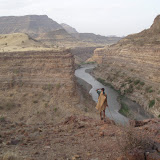
My way continued to the slopes of the valley of Tekeze, one of ethiopia's largest rivers.Unfortunetly a huge part of the valley will dissapear under an about 100km long reservoir after about one year. I went along the shore of the river untill near to it's source near Lalibela. The most exciting part, a narrow canyon will be flooded, the remaining part untill Lalibela was a bit boring. Along the river there is no population, the nearest villages lay on the slopes around 2 hours walk from the river, so only very few people have to be evacuated. Most people i met along the river were shepherds, leading their goats and cattle to the water.

The local authorities told me that the area is safe, so I could walk the whole distance from Dima to Lalibela alone. Sometimes i joined some passangers. The biggest danger I met along the way were the crocodiles, whom I had to escape at the countless rivercrossings. I was told that there also live many hyenas and and leopards, but they don't attack human beings. Besides the domestic animals I've also seen a lot of gelada baboons ( a monkey). They climbed in large groups of about 40 animals along the cliffs of the gorge. Last year I've also seen them in the Simien Park and they were always ready to pose for a photo , but here they were very shy and i could observe them only from far away.

Since the horrible droughts in the 70s Ethiopia is invaded by a galaxy of relief organizations, but in the remote areas they did change only little. Malnutrition is still omnipresent In the dry areas the women spend up to 4 hours to carry the daily ration of water in 20 liter canisters from the next river on steep paths up to their homes.

Lalibela, the small town where I write this entry is ethiopias most important historical site, with it's unique rock hewn churches. It's the first settlement since 3 weeks where i found electricity and water pipes! Tomorrow i'll reach the top of my trek (Abuna Josef, about 4300m) end will probably end up my tour in Korem , where i meet a friend i got to know from last year. Then i intend to go to Addis Abeba to plan my trip to Yemen, either by airplane or by bus and ship).

Freitag, 11. Januar 2008

From Port Sudan to Gedaref


The troubles with the police did not end yet: when i wanted to visit kassala on wednesday, the cops at the checkpoint at the outskirts of the city forced me to change the bus to go to gedaref. the problem was again the travel permit. i felt ashamed for the tears i was crying because of this ridiculous problem (i still have plenty of time to come back to kassala), compared to those of the poor people here, but my helplessness towards the police tied me into knots. i planned to go to gedaref later,as it's on the way to gonder (ethiopia) but kassala is much more beautiful, laying on the slope of a very impressive mountain. i hope i can get the permit for kassala tomorrow, after the office was closed on the weekend.

so far i don't have any further exciting stories to tell. i'm very disappointed how things went wrong and i wasted most of my time here in sudan, but on the other hand i'm looking forward to enter ethiopia next week. the permitterror will be over and i'll find endless mountain ranges to discover.

Dienstag, 8. Januar 2008

No expulsion, I can continue travelling

finally after 5 days of investigations the national security office received the order from khartoum to let me continue to travel in sudan freely. i don't know if this order is a result of interventions by austrian diplomats, but i think, if the suspicions by the police were really serious, they had already put me in jail.the only restriction i'm facing now is that i'm not allowed to trek in the mountains anymore. so i'll leave port sudan, heading to ethiopia through kassala and gedaref within about one week. there i'll find more freedom to travel as i've already found out 1 year ago.

i'm quite upset that my story and the blog were published everywhere in the austrian media. i didn't intend to become famous this way, but it's me who put me in this bad situation. i've travelled to many countries before, but i still have to learn a lot, especially about the "not to do's" in police states like sudan.

the last days were mentally very hard for me as i was not sure about the results and consequences of the investigations. to be convicted of spying in sudan for sure leads to a long-term imprisonment. but i have to mention that the police treated me well and was very friendly (there's nobody sitting behind me forcing me to write this), except for forbidding me phonecalls and later also to use the internet.

for all journalists, embassy officials, etc. : you can use this blog entry as a basis for further reports, but i'm not ready for any interview. my problem is solved now and everything about it is written in this blog. i think there are thousands of other austrians travelling around the world with much more exciting stories. thanks for all diplomats who tried to help me, i'm sorry for not answering the mails, but i was not allowed to.

Samstag, 5. Januar 2008

under supervision of sudanese police

well, the postcards didn't cause any troubles, but the articles about the former rebel groups definetly did. it was just soooooooo stupid to carry them in my luggage. they interrogated me for a few hours and they believe that i'm either a journalist or a spy.

currently the investigations are still running, but they told me that i'll most likely be expelled from sudan, the question is just: to ethiopia or to austria?

in the mean time (since 2 days) i can only move around in port sudan, always accompanied by a guy from the National Security Office. i'm not allowed to call anyone, but at least they let me surf and don't control the websites i'm visiting (probably they do afterwards).i hope that the remaining progress will be finished soon and i can move freely again.

the irony of my situation is that just untill to 2 months ago i worked for an organization assisting illegal foreigners in austria to return to their home country. now i can have a very authentic view from the reverse side, with the difference that there'll be no NGO supporting me. the austrian embassy here has very few influence.

Mittwoch, 2. Januar 2008

Trekkingtour in Red Sea Hills (Sudan)

Red Sea Hills

my apprehension became true: after a 6 days trek the police arrested me in a small village in the middle of nowhere. they didn't suspect me of anything, but somehow my permit was not valid for this area and they sent me back to port sudan.

the tour itself was great, with very diversified landscape: i started in erkowit, a village inside surprisingly green landscape on the edge of a big plateau. the hills looked like bunches of rocks that were just now thrown on the floor, without any erosion of wind and water. i stayed there one day to recover from some fever and diarroe. the weather there was quite cold and windy, sometimes even with tiny raindrops though the rainy season is in summer. then i met the typical red-brown eroded mountains with vegetation only on the bottom of the valleys like i knew it from earlier trips like sinai and ethiopia. after that i crossed a flat desert, fighting with sandstorms for a whole day to reach again the escarpment of the plateau to descent to the village where my tour ended forcefully.

but maybe the police even saved my life as they later told me in port sudan that there are landmines on the route where i wanted to continue. on the other hand the local people (who have to know about it better) didn't know about the mines so i think they only searched for a reason why i should be thankful to them, and not as angry as i appeared to them.

the landmines are the remains of a civil war in this region that ended with a peace agreement in october last year. the local ethnics, beja and rashaida, similar to darfur, felt marginalized and couldn't participate in the national politics, before the agreement. like in somalia, ethiopia and maybe other countries virtually all rebel groups in sudan are sponsored by the eritrean government. in port sudan i could met some leaders of the beja faction of the rebel group. they told me that they are very disappointed by the agreement, because most of the new government posts granted to them were occupied by the asmara-part of the group, which is rather interested in better relations between eritrea and sudan than the development of red sea region. the region is blessed with a lot of mineral resources like gold and uran and the most important oil pipeline from the oil fields in the south to the sea ports is crossing it, but the local people haven't seen any benefits from it.

the beja, who inhabit the area where i trekked are said to be very hostile towards foreigners, something i could not confirm. they were very friendly and rather worried about me and tried to convince me that it is too dangerous to go there alone. when their arguements came to an end they told me about lions living here, but i knew that the area is lion-free. sometimes i had communication problems because some of them speak only a few words arabic. most of them are raising goats, in the lowlands also camels.

today i had to apply again for a travel permit for another area close to port sudan. this time, they also checked and searched all the stuff of my bag. they confiscated stuff that were suspicious to them: some articles about the rebel groups (i can understand this) and some postcards from austria (!) that i use as gifts for the people i meet along the way. they said they'll investigate it and later , after my 2nd trekking tour will give it back to me. i'm anxious to the investigation's result.

Mittwoch, 19. Dezember 2007

From Asswan to Port Sudan


I had to travel to Port Sudan to recognize how cheap and comfortable the public transport in egypt is. the ferry trip from asswan to sudan on lake nasser was still nice, as the ship was not full and one could walk around anytime. somehow the captain took a wrong way at night and it took 28 hours for some 300km. but then the road (actually only a track) from wadi halfa, the port on the sudanese side, to atbara lead through empty sand desert. the average speed was around 35km/h but the road was so bumpy that the passengers were shaken into the air and hoped to land on the seat again. a lot of dust entered the bus. after some 3 hours the bus got broken and we were stuck in the desert for about 7 hours untill a car arrived to repair it.

one not only has to suffer on the busses, one also has to pay prizes of almost european standard, 42 euros for about 1000 km, compared with 10 euros for about the same distance in egypt.


police controls are much tighter here, foreigners have to register in the numerous checkpoints. on my upcoming trekking trip in the red sea mountains i chose a legal way with a permit that allows me to trek there even alone. but i m still a bit afraid to get arrested for "spying". the police doesn t hesitate to put foreigners in jail for ridicolous reasons. a british teacher was arrested for a few weeks because she allowed her students to call a teddy bear mohammed. in the streets of khartoum crowds of people even called for her execution.
hassan, my "couch surfing" host in port sudan, who was visited by the teacher before, spent some hours in custody because he carried plastic bags on the suq, which is forbidden because the goats on the market might eat them and become sick!


now i m stuck in port sudan because i m out of money and no visa card is working here because of the US embargo. somebody in asswan told me that it s actually working so i carried very few money to sudan. in this week the banks are all closed because of the hajj holiday, so i have to wait untill sunday untill i can pick up the money my father sent me by western union.


port sudan is not very well worth seeing, it was built by the british some 100 years ago as the main gateway to all parts of the world. it's mainly inhabitated by the beja, the local tribe, but also by many different ethnics from all over sudan. many foreigners lived here, mainly greeks and indians but most of them have left since the islamic regime of the current president, omar al bashir came to power. but they left behind some katholic, coptic and greek orthodox churches.
the people are less curious than in egypt, it's much harder to get in touch with them.
on the streets women are more present, most of those working serve shay or coffee on the wayside.
after i hopefully soon picked up the permit and the money i'll be off in the mountains for maybe up to 3 weeks. so don't worry if there's no blog entry the next time.


Donnerstag, 13. Dezember 2007

Asswan

asswan

So now I stayed 6 days in Asswan, and as intended, I leave all the temples, tombs and whatsoever behind without a visit, and I don't think that I missed out on anything. asswan is quite a busy city, but one just has to take the ferry from the city center across the nile and one enters a very calm, peaceful nubian village. though many families here depend on tourists, who take a ride on their fluka (sailing boat) or their camels next to the monuments, they've never tried to make any business with me, when i walked through the lanes and the paths along the water channels, that irrigate the fields, but tried their best to make me feel like at home.


most of the irrigated area is used to plant some kind of clover. they cut it bimonthly to feed their cattle, goats and camels. of course, there also grows much other stuff like banana, lemon, mango, marihuana and much more. they already discovered the pump there, but i also found some water mills run by a cow.

there also live some crocodiles here, they are said to become as long as 3 meters here, i've only seen a baby that disappeared in the high grass before i could take picture.

somehow there are no fishermen at all along the nile (on the leg i visited), they fish on lake nasser. some i met there on the lake told me that there's a predatory fish who sometimes even hunts fishers from their boats, reaching a length of 8 meters. due to the language barrier, they couldn't describe me what kind of fish this could be.

arabs and nubians live here together in peaceful harmony, conflicts between them are unknown. somehow the nubians are still discriminated by the government, as they have to adopt arabic names when they apply for a passport. their language exists only oral, and much vocabulary is removed by arabic words. for example they don't know a nubian word for "thank you".

melodies of nubian music reminded me of ethiopian sounds. i've not seen any group playing, they just showed me tracks from their mobile phones, modern arrangements with syntesizer. i've watched some arabic bands in asswan in the evening, sometimes quite good ones, but also here, all instruments except the drums were gathered in the synthesizer, like in a wonderlamp.
also in asswan the people are not irritated by the many tourists at all, i was often invited for a shay and shisha in the coffeeshops and they strictly hindered me to pay the bill, what made me feel ashamed, as it's not so easy to survive here and i have enough money spending a 1-year holiday. but my conscience was cleared when i paid something in any shop and recognized that they cheatet me, as they convulsed with laughter after i left.