My trip to the mountains started with a shock: My camera was stolen somewhere on the way to Manakha, including ALL pictures from my tour since egypt. But as I already took pictures of the area where i planned to trek I didn't return back to Sanaa imediately and continued.
The special thing about the landscape in Yemen is that the buildings on the cliffs and slopes in the mountains complement perfectly with their surroundings and often, from further away it's hard to define where the rock ends and the fundament of the building starts. One can find such fort villages just everywhere, which supports my way of trekking without a planned itinery.
After 3 days I met the next "harami" (criminal): A young man of my age made use of his djambia (the traditional dagger most yemenis wear on their belt) to rob my money, but as i knew his house (i spent the previous night there) i just asked some locals for help to demand my money back from his father, successfully. Later they told me that he will be arrested for 1 year. Seems like a court investigation is not nessecary in Yemen for such a long term. So much about the bad incidents.
Just one day later, in a small village called beit anaheim, i spontaneously decided to start teaching english at the school volunteerly after i found out that they don't have an english teacher there, but my career lasted only 3 days, then police moved into the village to resolve a local land dispute nearby and they wouldn't have accepted me as a teacher there as i have no working visa. Nonetheless it was an interesting experience.The class starts in the morning with a strange, half an hour lasting ceremony, similary to what i've seen in a school in sinai: it's a mix of gymnastics and a military parade without weapons and instruments. At the end the students show the teacher,who leads the ceremony, their clean hands, and if they're dirty they'll be cleaned by hitting them with a stick. Beating up the students with a stick is not considered here as a crime, but as a necessity to push their ambition. Every single person I asked later about this, shared the same mind. Though I totally disagree with this opinion, I have to admit that this circumstances made it much easier for me to teach there, as i have no experience to work with children and lack of any authoritarian character.
So I continued still 2 days to trek north to wadi surdud, a remarkably big and clear stream for yemenite means, and from there up to the main road connecting al mahweet with sanaa, where i took a lift back to sanaa. I bought an oud (arabic guitar) for some 160 euros, attended an ethiopian nightclub to renew my amharic and vibrate my shoulders, and returned near to al makhweet to continue my trek where it ended, after it turned out that the police in beit anaheim would stay longer.
In the mean time the rainy season had started with one month delay, and in the afternoons the wadis were filled with brown,muddy rivers, but fortunately not strong enough to hinder from crossing on foot or by car. Near Hajja I passed by many fresh cadavers of donkeys and goats which were surprised by the floods. In Sanaa the streams on the streets are raising very fast because there aren't any spillways.
In Yemen, even the most isolated village has road access, and many times i didn't mind to jump on one of the occasionally passing by pick-ups, as the speed on the difficult roads is very slow, and it's nice to observe the surroundings with an open air view.
Most people I met on the way called themselve bedu, though they were neither nomadic nor had a significant darker skin than the city people, like in egypt, but at least I've found their legendary hospitality. Some people, the "akhdam", have also some obvious african traces in their faces. In the Tihama, the coastal strip along the red sea there are more of them to find, living in african style huts, but here they assimilated entirely.
In all areas,whenever the dawn was near, the people warned me not to sleep outside as there might be some leopards. I was not sure if i should believe them, but if they really exist, for sure they are very afraid of human beings, as many yemenites carry kalashnikows in addition to their djambia, and wouldn't hesitate to shot them. One guy showed me a tail of a cat of prey hanging from the ceiling of his living room,(looked like from a leopard)which he claimed to have hunted down.
In an area south of shahara, some men asked me if i'd have a metal detector to help them to find old coins from the hameri kingdom (bilquis, the legendary queen of sheba was one of it's reigns), but i had to decline. They said their area is full of them and the rain would erode the soil and might release some tresures. But I tought them that the famous coin of Maria Theresia, which is very popular in Yemen and sometimes still used as a currency, is not from France as most yemenites believe but from my country.
Shahara should become the final destination of my tour, walking further north would lead me to the civil war of Sadaa. Shahara is famous for it's old bridge connecting two vertical cliffs, a must for the photo album of the ordinary tourist. On the pictures I've seen on the internet it looks very impressive but actually it's hardly longer than 10 metres. The village itself is not much worth seen, but the scenery of the mountain top where it's built on all the more. There are two tourist hotels, which frightened me with their high fee of about 12 euros per night which i could drop to 8 euros after routinely bargaining, but the excellent dinner and the breakfast included in the fee alone were worth at least 8 euros, not to mention my first hot shower since I left austria.
Sonntag, 11. Mai 2008

Donnerstag, 17. April 2008
Socotra

When I returned back to Sanaa yesterday evening, I had the feeling that something was missing on my 2 weeks trip on Socotra, but now I think that after 5 months on the road, path, rail, ship, plane or whatever my feelings became quite blunted and even for unique places like Socotra it's hard to enthuse me.
In fact I had an adventurous trekking tour as usual, starting through the Haggier mountains in the center of the island, that reminded me a bit of the alps, with it's grey limestone and darkgreen bushes, along mountain rivers lined with palm trees and backed up to many natural swimming pools which are hard to pass by without a refreshing bath. After 6 days of flush of water I crossed a dry karst plateau with some dragonblood and francinsence trees and was surprised not to find water in the canyon where I descended next. The canyon surprisingly ended in a stalactite cave, which raised my hope again, but the drops all disappeared in the ground. The next day, after my water was finished and I started to drink my urine I was forced to exploit the water reserves of a temporary left alone home in one of the many caves. Then I soon reached the southern coastal strip, which has not much to offer and I stopped a car to Mahfirin, a fisher village where I had a rest for 1 day and stocked up with food. Then a further 3 days along the cliff line of the eastern part of the island, where I had my first aquintences with tourists outside of Hadibo. The tourist attractions there were a cool spring coming out of a huge, steep, white sand dune and another but more interesting stalactite cave. The majority of these tourists (and in Yemen in general) came from Italy and some Socotris who occasionally work with tourists speak better italian than english. After I returned to Hadibo, the capitol I still had 1 day to go to Galansyia in the far west to relax on the sand beach there.
The people on Socotra mainly depend on their goats, on the coast of course from the fish, but the strong monsoon wind in summer forces them to stay on the land for 3 month every year. Agriculture is very rare, probably worth to mention dats, but francinsence and the red extract of the dragonblood tree (the "dragonblood", which is used as cure and as facial lotion for women) which are sold for 2 euro per about 50 gramm. The Socotris live in very simple stone houses which lack of any decoration, quite similar to those of the Bedu on Sinai, also the wealthier ones. Most have more than one home (up to 5), some also live in caves. Though entirely veiled and always refusing to pose for a picture, the women have a much more confident behaviour than on the yemeni mainland and it's no problem to have a chat with them. I was too lazy to learn some phrases of the local language socotri, as 100% speak arabic fluently. But it was interesting to notice that they call foreigners "farenji" , like in Ethiopia. They also have some common customs with the Somali and Afar like dunking the hand in a porringer before and after consuming food (usually rice, on the coast supplemented with fresh fish) or go great each other by kissing someones hand (if they don't great by touching nose and nose), though most of them have their origin in Mahra in eastern Yemen, which used to be a kingdom including Socotra. There are also some fishermen with obviously pure african faces, but somehow they don't know where their ancestors came from and assimilated to the socotries.
On Socotra I enjoyed 100% freedom of movement, in contrary to the mainland, where I'm supposed to apply for travel permits again. But in contrast to Sudan, the policemen do not notice that I'm a foreigner, when I travel by public transport, and it's no big risk to move off the itinery of my permit, in the case that I want to change my program. In the worst case I'll be sent back to Sanaa. I just have to avoid the areas where kidnappings took place, and I'm sure that I'm well informed about it now.
Dienstag, 1. April 2008
From Djibouti to Sanaa (Yemen)

I've spend quite a boring week in Djibouti city and it's surroundings. I didn't really make contacts with the nomads living there, but I visited almost every single police station of this small state. When I asked them for the reason of their interrogations I only received stupid answers like "Il n'y a pas de probleme" or "C'est pour votre securite". For the first time in my life I also had to give my fingerprints.
The reason I stayed so long was that I had to wait for the ship to Yemen. There is no regular passenger ferry, only cargo ships waiting for goods from Ethiopia. The goods of my ship had been cows. There are no regular schedules and it's not easy to find out, when a ship will leave. When I entered the ship I also found out that I paid 40 euros too much for the ship and could have gone by airplane for the same price. Anyway, even if the airplane was really cheaper I had prefered the ship to cross through the legendary bab el mandeb (gate of lamentation). The ship was quite small with some 15 passengers, 5 crew members and about 100 ethiopian cows, a very familial sentiment.
I entered yemenese soil at Mukha and then went straight to Sanaa, after spending the night in Taiz. Yemen has awsome opportunities for mountain trekking tours, but first i'll discover the not much known island of Socotra in the Indian Ocean. It's closer to the somali coast, but belongs to Yemen. For this destination it is hard to avoid the airplane and I fortunately found a flight for tomorrow. I'm sure I'll have a great time there, I'm just worried about the huge flesh wound on my right hand that still is not cured. It's a memory from the too low ventilator in my room in a "habash" restaurant in djibouti, where i could stay for free, but had to share it with some locusts and cockroachs.
The reason I stayed so long was that I had to wait for the ship to Yemen. There is no regular passenger ferry, only cargo ships waiting for goods from Ethiopia. The goods of my ship had been cows. There are no regular schedules and it's not easy to find out, when a ship will leave. When I entered the ship I also found out that I paid 40 euros too much for the ship and could have gone by airplane for the same price. Anyway, even if the airplane was really cheaper I had prefered the ship to cross through the legendary bab el mandeb (gate of lamentation). The ship was quite small with some 15 passengers, 5 crew members and about 100 ethiopian cows, a very familial sentiment.
I entered yemenese soil at Mukha and then went straight to Sanaa, after spending the night in Taiz. Yemen has awsome opportunities for mountain trekking tours, but first i'll discover the not much known island of Socotra in the Indian Ocean. It's closer to the somali coast, but belongs to Yemen. For this destination it is hard to avoid the airplane and I fortunately found a flight for tomorrow. I'm sure I'll have a great time there, I'm just worried about the huge flesh wound on my right hand that still is not cured. It's a memory from the too low ventilator in my room in a "habash" restaurant in djibouti, where i could stay for free, but had to share it with some locusts and cockroachs.
Sonntag, 23. März 2008
From Harer to Djibouti

The last part of my ethiopia-journey lead me to the Afar region. The most exciting place to visit there is Erta Ale, the world`s only lava lake, but as there were some kidnappings in the last time I better stayed in a safer area around Assaita, the biggest Afar city. There the Awash river, bringing all the liquid waste from Addis Abeba, flows through several lakes untill he ends in the Afambo lake.
Assaita and the settlements along the Djibouti road host a large amharic population. Most of them came here to serve the hungry and tired truck drivers with restaurants and hotels (it`s probably the most frequented road of Ethiopia, as it`s the main connection of the contry to the ports of the world). But I was told that there is no conflict between the two ethnics, they (the Afar) rather have occasional clashes with the Issa, a somali tribe.
The backbone of the Afar is, of course, livestock, and in some areas salt plantation. Agriculture is only possible along the marshlands of Awash.
From the tourist office in Samara (it`s the regional capital but only consists of a cluster of administrational buidlings, very strange settlement) I took an official guide and a permission to go to the Afambo lake. From there I joined a camel caravan for a 3 day walk through empty desert untill Dikhil in Djibouti. It was a nice experience to see the caravan` s daily life but I wouldn`t recommend this tour to others, because the landscape after the lakes is very boring (only lava stones and, sometimes, an acacia tree) and the border crossing was illegal, so i had to go by truck from Dikhil to the border post in order to get my exit and visa stamps. Along some 100 km we (me and the caravan) didn`t encounter any settlements (except some stone cairns which protected us from the nightly desert storms) and no water, and as they fetched their water from the Afambo lake, I didn`t have any other choice than to drink the infamous "Addis Abeba water".
From the border it wasn't far to the capitol and main port, also called Djibouti. Like the Afar region in Ethiopia, Djibouti is mainly inhabitated by Afar and Issa, but in addition to their own languages and french (Djibouti is francophone) most of them speak also arabic and some amharic, which often leads to trilingual dialogues when I get in touch with them. Of course one also meets a lot of arab traders and, easily to indentify by their tough haircut and chunky bodies, american and french soldiers from the nearby military bases.
Since I left Harer I wear a Imama (turban) to protect my head from the heat, and I'm getting tired to explain that I'm no muslim. Just yesterday some bored policemen disturbed me half an hour with stupid question because I confused them (Atheist, austrian name and passport, looks like a muslim, speaks arabic...)
Assaita and the settlements along the Djibouti road host a large amharic population. Most of them came here to serve the hungry and tired truck drivers with restaurants and hotels (it`s probably the most frequented road of Ethiopia, as it`s the main connection of the contry to the ports of the world). But I was told that there is no conflict between the two ethnics, they (the Afar) rather have occasional clashes with the Issa, a somali tribe.
The backbone of the Afar is, of course, livestock, and in some areas salt plantation. Agriculture is only possible along the marshlands of Awash.
From the tourist office in Samara (it`s the regional capital but only consists of a cluster of administrational buidlings, very strange settlement) I took an official guide and a permission to go to the Afambo lake. From there I joined a camel caravan for a 3 day walk through empty desert untill Dikhil in Djibouti. It was a nice experience to see the caravan` s daily life but I wouldn`t recommend this tour to others, because the landscape after the lakes is very boring (only lava stones and, sometimes, an acacia tree) and the border crossing was illegal, so i had to go by truck from Dikhil to the border post in order to get my exit and visa stamps. Along some 100 km we (me and the caravan) didn`t encounter any settlements (except some stone cairns which protected us from the nightly desert storms) and no water, and as they fetched their water from the Afambo lake, I didn`t have any other choice than to drink the infamous "Addis Abeba water".
From the border it wasn't far to the capitol and main port, also called Djibouti. Like the Afar region in Ethiopia, Djibouti is mainly inhabitated by Afar and Issa, but in addition to their own languages and french (Djibouti is francophone) most of them speak also arabic and some amharic, which often leads to trilingual dialogues when I get in touch with them. Of course one also meets a lot of arab traders and, easily to indentify by their tough haircut and chunky bodies, american and french soldiers from the nearby military bases.
Since I left Harer I wear a Imama (turban) to protect my head from the heat, and I'm getting tired to explain that I'm no muslim. Just yesterday some bored policemen disturbed me half an hour with stupid question because I confused them (Atheist, austrian name and passport, looks like a muslim, speaks arabic...)
Mittwoch, 12. März 2008
Harer

I seperated in peace from the "new flower" (Addis Abeba translated to english)and fell in love with Harer at first sight. It's the only city in Ethiopia with a real old town. It has it's very own style of houses (especially the sitting plateaus inside), and even it's own language, only spoken inside Jogul, the old wall embracing it. Harari is a mix of arabic, amharic, oromo, somali and many other languages.
Also the harari folk songs are a refreshing alternate, they sound quite arabic. Regrettably I didn't find any live performance at this time, only bought some records, contrary to it's amharic counterparts in Lalibela and Addis, performed in a so called "asmari bet" , some kind of traditional night club (I forgot to mention it in the previous entries). Eventually I master the amharic "skisa" - dance, which is best described with joggling one's shoulders, to some extent.
Harer is an old trading city. The most important product sold here is Khat, a narcotic leaf, the nr.1 drug in Yemen, Somalia and some parts of Ethiopia. I tried it before several times in Yemen and Ethiopia, but I couldn't get used to it's bitter taste, and also couldn't feel any stimualtion. Unfortunetly the surrounding of harer is covered by a sea of blue plastic inwhich the khat is sold.
Now I stayed here for 5 days, including a day trip to Babile (1 hour by bus from harer), where I took a walk through an amazing stone forest, only angered by the cactus alongside the overgrown paths. Though I really like it here and found some new friends again, I'm quite disappointed now about my soon ending stay in Ethiopia. Within 2 months I couldn't find a place in the rural areas to integrate into the farmer's daily life, like I hoped to do. I've always been always a visitor and most acquaintances were rather cursory.But I'm still far away from feeling homesick.
Also the harari folk songs are a refreshing alternate, they sound quite arabic. Regrettably I didn't find any live performance at this time, only bought some records, contrary to it's amharic counterparts in Lalibela and Addis, performed in a so called "asmari bet" , some kind of traditional night club (I forgot to mention it in the previous entries). Eventually I master the amharic "skisa" - dance, which is best described with joggling one's shoulders, to some extent.
Harer is an old trading city. The most important product sold here is Khat, a narcotic leaf, the nr.1 drug in Yemen, Somalia and some parts of Ethiopia. I tried it before several times in Yemen and Ethiopia, but I couldn't get used to it's bitter taste, and also couldn't feel any stimualtion. Unfortunetly the surrounding of harer is covered by a sea of blue plastic inwhich the khat is sold.
Now I stayed here for 5 days, including a day trip to Babile (1 hour by bus from harer), where I took a walk through an amazing stone forest, only angered by the cactus alongside the overgrown paths. Though I really like it here and found some new friends again, I'm quite disappointed now about my soon ending stay in Ethiopia. Within 2 months I couldn't find a place in the rural areas to integrate into the farmer's daily life, like I hoped to do. I've always been always a visitor and most acquaintances were rather cursory.But I'm still far away from feeling homesick.
Freitag, 7. März 2008
From Lalibela to Addis
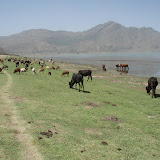 |
| From Lalibela to Addis |
Since friday i'm in Addis Abeba. I reached Korem after a 2 days trek and 1 day by bus, and stayed there 2 days , including a visit to the beautiful Ashange mountain lake. Then I still tried to make a trip to the nearby Afar Region in the east and sacrificied 2 days with running from one local authority to the other to get a permission, but without any success. The Afar nomads are known to be very hostile not only for "farenji" (white men like me) but also for other ethiopian ethnics. So it would have been nessecary to take a guide from their tribe in order not to be abducted or even killed. Their homeland is the hottest area in Ethiopia, flat pastoral land, interrupted by many extinct and active volcanoes and salt lakes, very different from the highland. Maybe I'll try it again from their regional capital Samara, when I'm on the way to Djibouti.
Here in Addis I stay with some Somali friend's friends, refugees from Mogadischu who are waiting for their visa to follow their relatives in Austria or other western countries. The Djibouti Visa is also the only reason why i still didn't leave this monster city, mainly consisting of corrugated iron buildings and shopping malls next to each other, without any single park or other alternations. I should get the visa tomorrow, then i'll go to Harer , a historical islamic trading city, most probably better worth seeing. It's only 2 hours (in Ethiopia a ridiculous distance) from Jijiga, the capital of Somali Regional State, which i have to avoid in order not to get into the same situation like in the new year, as there is still a long lasting guerilla war in it's hinterland.
I still have problems loading the pictures, it would simply take days (without sleeping) untill I've loaded all important images. Maybe in Djibouti it's better. Also I cannot open my blog here in Ethiopia, (seems to be censored by the government) and I have to mail the texts of the entries to my sister in austria.
Donnerstag, 21. Februar 2008
I am still alive ( in Ethiopia)
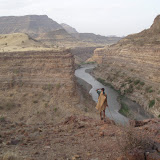 |
| Kassala |
I just couldn't find any opportunity to write a new blog entry in the rural areas of northern ethiopia during the last 4 weeks and on the day I stayed in Gonder, my first stopover within Ethiopia , www.blogger.com was not accessable.
So what happened in the mean time? My second attemp to conquer Kassala turned out to be successful and I stayed there for 5 days. Though it's one of the biggest and most famous cities of Sudan, it's character is rather like a big village. The "downtown" is very small and as ugly as most other cities, and after 9 p.m. the streets are entirely empty. Only during ramadan , as I was told, the city gets more alive, because many sudanese couples spend their honeymoon there. Like me, they are attracted by the coulisse of the famous Tutil mountain nearby.
As Kassala is very close to the border with Eritrea, it's consequential that a huge part of the population has it's roots there. I got to know a lot of Habbasha (a word describing the semitic ethnics of Eritrea and Ethiopia like Amhara, Tigray) who were on their illegal way to europe, by crossing the deadly Lybian desert and the Mediterrean Sea. They either fled from repressions from their governments (mainly Eritrean soldiers defecting from the army) or just looked for a better life. I also was happy to find injera (ethiopian food) as the popular sudanese cuisine is dominated by ful (beans) with few alternativees and gets boring after some time.
From Kassala it was a 2 days drive to Gonder. This city is famous for it's portuguese style castle, datingback from the time when it was the ethiopian capital. It's frequented by a lot of western tourist. On the streets one gets subsequently disturbed by "you you" shouting of the kids, and if one asks for a hotel,bus or other information, people expect money if they help you. While the people in Sudan are used to see Egyptians, Turks and Indians living there (most of them thought that I'm from Pakistan) here it's too obvious that I'm a tourist.So especially after my trekking tour in sudan was so short, I couldn't await to see the countryside and left Gonder after 1 day. On the same day there was the celebration of Timkat (Epiphancy) and Gonder might be one of the best places to see it, but the large crowds on the streets scared me off. After 1 hour by bus to Kossoye and 3 hours walk i arrived at a beautiful site next to a river.Throughout the night the priests were singing beautiful church songs and in the morning they blessed the people with the water from the river.
Then a 6 days trek to Debark followed.The big difference to my tours in Egypt and Sudan was that I crossed densly populated farmlands, walking on the main roads connecting the villages, meeting much more peole on the way. Just this "main roads" are unaccessible by car and there is not any other kind of infrastructure like elictricity, water pipes,etc.
On the way to Debark I learnt that there occur occasionally robberies in this area and sometimes I was accompanied by some local militia (1 or 2 gunmen). The nights I usually spent in the houses of the government workers (teachers, municipal managers, agricultural advisors,..) They speak quite good english and one can find them in every Kebele (the smallest administrational unit, like a municipal. Almost everywhere I was told to be the first foreigner visitor since the italian invadors during the 2nd world war. Sometimes I got a bit paranoid, because everybody, espacially swarms of kids followed me to everywhere, just staring and observing every single move, but from time to time i got used to it.
From Debark i went by a truck to Dima, a small town north of the Simien Mountains Nationalpark. I visited the park 1 year ago and this time i wanted to avoid the entrance fee, the surrounding landscape is not less impressive. In this area I saw very different vegetational zones within a few kilometres. While on the mountains there is rain all year around, enabling eucalyptus and juniper (looks like a fir) I've found semi desert area down in the valleys below about 1800m sea level , dominated by akazia and cactus. Here the wealth of the farmers depends from the seasonal rain between may and september. In that time they are often cutoff from the outside world, stuck between flooded river beds and 4000m high mountains. In some places they started to irrigate the rivers a few years ago to plant banana and papaya trees, very unusual fruits in this area.
My way continued to the slopes of the valley of Tekeze, one of ethiopia's largest rivers.Unfortunetly a huge part of the valley will dissapear under an about 100km long reservoir after about one year. I went along the shore of the river untill near to it's source near Lalibela. The most exciting part, a narrow canyon will be flooded, the remaining part untill Lalibela was a bit boring. Along the river there is no population, the nearest villages lay on the slopes around 2 hours walk from the river, so only very few people have to be evacuated. Most people i met along the river were shepherds, leading their goats and cattle to the water.
The local authorities told me that the area is safe, so I could walk the whole distance from Dima to Lalibela alone. Sometimes i joined some passangers. The biggest danger I met along the way were the crocodiles, whom I had to escape at the countless rivercrossings. I was told that there also live many hyenas and and leopards, but they don't attack human beings. Besides the domestic animals I've also seen a lot of gelada baboons ( a monkey). They climbed in large groups of about 40 animals along the cliffs of the gorge. Last year I've also seen them in the Simien Park and they were always ready to pose for a photo , but here they were very shy and i could observe them only from far away.
Since the horrible droughts in the 70s Ethiopia is invaded by a galaxy of relief organizations, but in the remote areas they did change only little. Malnutrition is still omnipresent In the dry areas the women spend up to 4 hours to carry the daily ration of water in 20 liter canisters from the next river on steep paths up to their homes.
Lalibela, the small town where I write this entry is ethiopias most important historical site, with it's unique rock hewn churches. It's the first settlement since 3 weeks where i found electricity and water pipes! Tomorrow i'll reach the top of my trek (Abuna Josef, about 4300m) end will probably end up my tour in Korem , where i meet a friend i got to know from last year. Then i intend to go to Addis Abeba to plan my trip to Yemen, either by airplane or by bus and ship).
Abonnieren
Posts (Atom)
